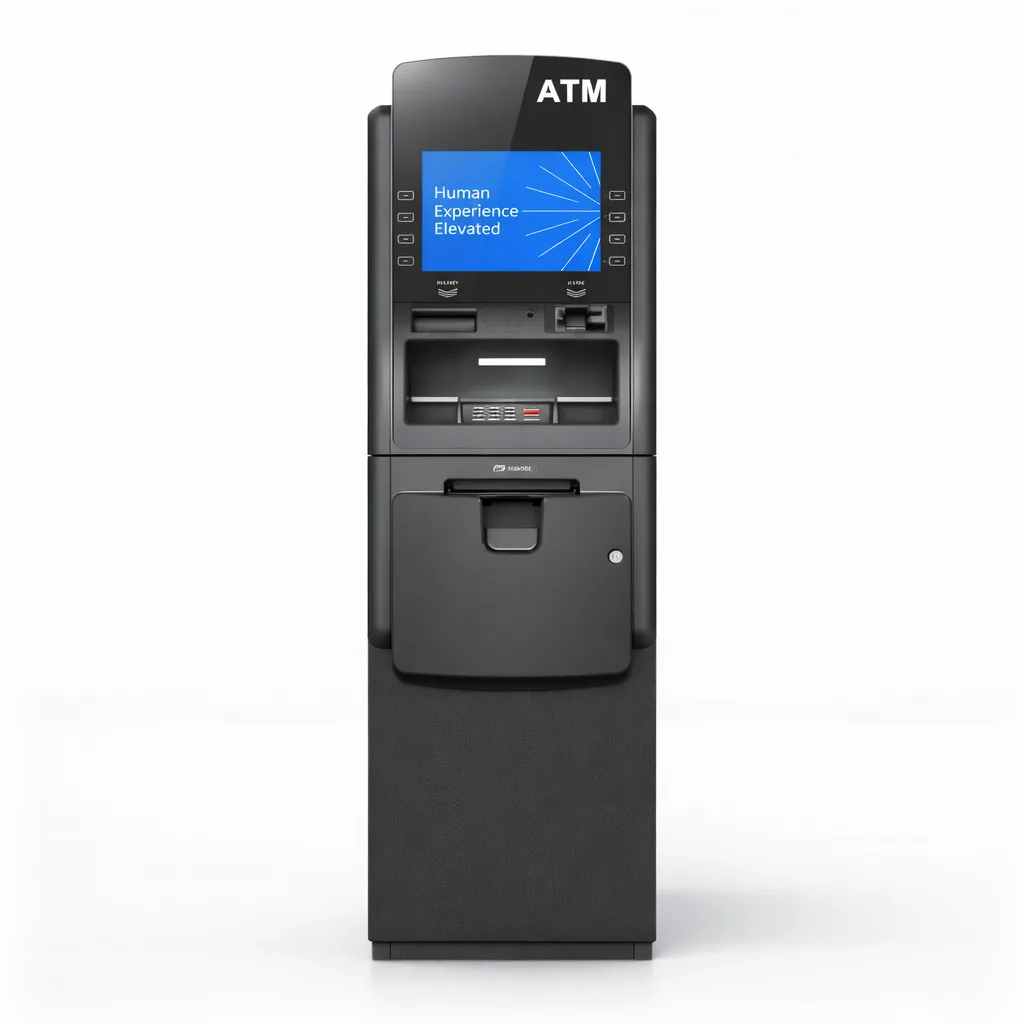
An ATM surcharge is the fee the machine owner charges every time someone uses their ATM. The national average in 2025 is $3.22 per transaction, according to Bankrate’s annual study. That is the operator’s share only. On top of that, your own bank typically charges $1.64 for using an out-of-network ATM, bringing the average total to $4.86 per withdrawal. If you own an ATM, the surcharge is your primary source of profit, and you set the amount yourself.
If you have ever walked up to an ATM, asked for $40, and then watched a fee screen appear telling you it is going to cost you $3.50 just to get to your own money, you know how surcharge fees feel from the customer side. If you own or are considering owning an ATM, the surcharge is the other side of that equation: it is the entire business model.
This guide explains both perspectives. What the fee is, who gets it, how the national average has changed over time, what operators charge across different location types, how to set a surcharge if you own a machine, and what the legal requirements are around disclosing it.
$3.22
Average ATM operator surcharge in 2025 (Bankrate). Fourth consecutive year at a record high.
$1.64
Average out-of-network fee from your own bank, charged on top of the operator surcharge
$4.86
Average total cost of an out-of-network ATM transaction. Up from $1.97 in 1998.
$1–$9.99
Full range of ATM surcharges in the U.S. Some Las Vegas casino ATMs charge $9.99.
What Is an ATM Surcharge Fee?
An ATM surcharge is the fee charged by the owner of the ATM machine for the service of letting you access your cash there. It is separate from any fee your bank charges. The ATM owner sets this fee, collects it, and keeps it as revenue.
When you use an ATM that does not belong to your bank, two separate fees are typically triggered at the same moment:
| Fee Type | Who Charges It | 2025 Average | Who Gets the Money |
|---|---|---|---|
| ATM surcharge (operator fee) | The ATM owner (bank, independent operator, or business) | $3.22 | The ATM owner |
| Out-of-network fee (bank fee) | Your own bank or credit union | $1.64 | Your bank |
| Total out-of-network cost | Both combined | $4.86 | Split between ATM owner and your bank |
The ATM surcharge is the one you see on the screen before you confirm the transaction. Federal law (the Electronic Fund Transfer Act and Regulation E) requires that the surcharge be displayed clearly on screen before the customer commits to the withdrawal, and the customer must be given the option to cancel at no charge if they do not want to pay it. The bank’s out-of-network fee typically appears on your bank statement afterward rather than on the ATM screen.
The average total cost of an out-of-network ATM withdrawal was $1.97 in 1998 when Bankrate first started tracking it. By 2025, it had reached $4.86, an increase of nearly 150 percent over 27 years. The operator surcharge portion has hit a record high for four consecutive years.
What ATM Surcharges Look Like by Location Type
Surcharge amounts vary significantly based on where the ATM is located. The logic follows convenience and competition: where alternatives are scarce and urgency is high, operators charge more. Where multiple ATMs compete nearby, the market pushes fees down.
| Location Type | Typical Surcharge Range | Why |
|---|---|---|
| Convenience store / gas station | $2.50 to $3.50 | Competitive market. Many alternatives nearby. Price sensitivity is moderate. |
| Bar or restaurant | $2.50 to $3.50 | Customers are already spending money. Surcharge is seen as minor relative to the tab. |
| Hotel lobby | $3.00 to $4.00 | Captive audience. Guests do not want to leave the hotel to find an ATM. |
| Nightclub or music venue | $3.00 to $5.00 | Customers inside the venue cannot easily leave and come back. Urgency is high. |
| Airport | $4.00 to $6.00 | Passengers cannot leave to find cheaper alternatives. Very high urgency and captive audience. |
| Casino floor | $4.00 to $9.99 | Customers are in a high-spending, cash-heavy environment. Surcharge tolerance is the highest of any location type. |
| Near university campus | $2.00 to $2.75 | Price-sensitive demographic. Lower fee drives higher volume. |
| Rural or low-competition area | $2.50 to $4.00 | No nearby competition allows slightly higher pricing, but volume is low. |
City-by-city differences are also meaningful. According to Bankrate’s 2025 study, Atlanta has the highest average total ATM fee at $5.37, while Boston has the lowest at $4.37. Phoenix and San Diego both averaged $5.22. These regional differences reflect local competition levels, cost of living, and the mix of location types where ATMs are deployed in each market.
Who Sets the ATM Surcharge?
The ATM operator sets the surcharge. Period. If you own the machine, you control the fee. You can set it anywhere from $0 to whatever the market will tolerate. You change it any time you want by updating the setting in your machine’s operator menu or by contacting your ATM processor and requesting a fee change, which typically takes effect within 24 hours.
The ATM processor (the company that connects your machine to the banking networks) does not set the surcharge. Your location partner does not set it unless you have agreed to give them that control. The bank that holds your settlement account does not set it. It is entirely your decision as the machine owner.
If you have a location agreement with a business that hosts your ATM, that agreement may include provisions about the surcharge, such as a minimum fee that ensures the business gets a meaningful revenue share, or a maximum fee to protect customer relationships. But those constraints come from your private contract, not from any law or network rule that applies universally.
How Surcharge Revenue Works: The Operator’s Economics
The surcharge is the ATM business model. Every dollar of surcharge that a customer pays goes to the ATM owner, not to the bank, not to the processor, and not to the network (with some minor exceptions around interchange, which is a separate and much smaller revenue component).
Here is what the revenue flow looks like for a straightforward independent deployment:
The customer’s bank account is debited $103. The $100 was physically dispensed from your cassette.
Within 24 to 48 hours, your processor deposits $103 into your bank account via ACH. The $100 reimburses your vault cash. The $3.00 is your surcharge revenue.
Your processor charges monthly fees typically ranging from $15 to $30 for their services. Some processors also charge a per-transaction fee of $0.05 to $0.15 or take a cut of the surcharge. Know your processor’s fee structure when calculating net revenue.
If you have a placement agreement with the business that hosts your ATM, you typically share a portion of the surcharge with them. This is often $0.25 to $1.00 per transaction or a percentage of the surcharge, negotiated in your placement contract.
Surcharge revenue minus processor fees minus location share minus operating costs (paper, maintenance, wireless fees) equals your take-home profit per transaction. For a well-placed ATM doing 150 transactions per month at a $3.00 surcharge, that is $450 in gross surcharge revenue before deductions.
Revenue Calculator Example
| Scenario | Surcharge | Transactions/Mo | Gross Revenue | Net (est. after costs) |
|---|---|---|---|---|
| Low-volume bar | $2.50 | 80 | $200 | ~$140 |
| Average convenience store | $3.00 | 150 | $450 | ~$320 |
| Busy nightclub | $4.00 | 300 | $1,200 | ~$880 |
| Hotel lobby | $3.50 | 200 | $700 | ~$510 |
Estimated net figures above assume roughly $60 to $70 per month in processor fees, receipt paper, and wireless connectivity, and approximately 20 to 25 percent shared with the location owner. Actual numbers vary significantly by your specific agreements and costs.
How to Set Your ATM Surcharge: A Practical Framework
Setting the right surcharge for a new machine is one of the first decisions every new operator faces. There is no universal right answer, but there is a logical process for getting to a good starting point.
Step 1: Survey the Local Market
Visit every ATM within half a mile of your location and write down what each one charges. Gas stations, convenience stores, bank branches, other bars or hotels. You are building a picture of what local customers are already accustomed to paying. If every machine near you charges $3.00, starting at $4.50 will send customers to the competition. If the nearest competing ATM is three blocks away and charges $2.50, you have room to price at $3.00 without much risk.
Step 2: Assess Your Location’s Convenience Premium
How much would a customer have to go out of their way to find a different ATM? If your machine is the only one inside a nightclub where leaving means losing your spot and paying a cover charge again, your convenience premium is very high. If there is a bank ATM two doors down, your premium is low and your price needs to reflect that.
Step 3: Run the Math on Minimum Viable Revenue
Calculate what you need to cover your costs and hit your ROI target. Here is the basic formula:
(Machine cost + installation + initial cash) ÷ target payback period in months
= minimum monthly net revenue needed
Add monthly operating costs (processor $15–30 + wireless $15–40 + paper + maintenance)
= total monthly gross revenue needed
Divide by expected transactions per month
= minimum surcharge required
If the math says you need $2.75 per transaction and the market supports $3.00 to $3.25, you have comfortable margin. If it says you need $3.50 and the market will only bear $2.50, the location economics do not work at that volume and you need either more transactions or a different location.
Step 4: Start Moderate and Adjust
Most experienced operators recommend setting your initial surcharge in the middle of the local range, running it for 60 to 90 days, and then evaluating. Watch three numbers: total transactions per month, the cancel rate (how often people see the fee and walk away), and cash-out frequency (how often the machine empties). If the cancel rate is high and transaction volume is low, consider dropping the fee. If transactions are strong and volume is growing, you may have room to test a modest increase.
Raising your surcharge by $0.25 feels like easy money, but the math is not always that simple. A surcharge of $3.50 with 400 monthly transactions generates $1,400. A surcharge of $2.75 with 520 transactions generates $1,430. If a $0.75 reduction in your fee picks up 120 more transactions per month (about 4 extra per day), you come out ahead at the lower price. The only way to know how your specific location responds is to test and measure.
Step 5: Never Set and Forget
Your surcharge should be reviewed at least quarterly. Local competition changes when a new ATM goes in nearby. Transaction volume changes with seasons, new businesses opening, or shifts in the neighborhood. What was the right fee in January may leave money on the table or cost you transactions in July.
Surcharge Legal Requirements: What Operators Must Do
The Electronic Fund Transfer Act (EFTA) and its implementing regulation, Regulation E, set the disclosure requirements that every ATM operator in the United States must follow. These are not optional and non-compliance can expose operators to liability.
- On-screen disclosure before the transaction: The ATM must display the surcharge amount clearly on screen before the customer confirms the withdrawal. The customer must have the option to cancel the transaction at no charge if they do not want to pay the fee.
- Receipt disclosure: If a receipt is printed, the surcharge amount must appear on it as a separate line item.
- Physical signage (legacy requirement): A previous EFTA requirement mandated a physical notice on or near the ATM stating that a surcharge would be charged. The Dodd-Frank Act removed this specific physical signage requirement at the federal level, but some states still have their own requirements. Check your state’s ATM regulations.
Most retail ATM machines display the surcharge disclosure automatically as part of their standard transaction flow. If you have configured your machine through an authorized dealer and processor, this is almost certainly set up correctly. If you are using a second-hand machine with custom software, confirm that the fee screen appears and is accurate before putting the machine in service.
Surcharge-Free ATMs: When Zero Makes Sense
Not every ATM has a surcharge. Banks and credit unions typically offer their own customers fee-free access to in-network ATMs. Independent operators occasionally deploy surcharge-free machines in specific situations:
- Store owner with an in-store ATM: A retailer who owns their own ATM and sees a clear link between ATM access and in-store spending may forgo the surcharge entirely, reasoning that the foot traffic and spending generated by a free ATM outweighs the fee revenue they are giving up.
- BIN blocking for member institutions: Some ATM operators configure their machines to charge non-customers the standard surcharge while blocking the surcharge for cardholders from a specific credit union or bank. This is called BIN blocking and is used as a loyalty or partnership tool.
- New machine in a competitive market: Some new operators start with a very low fee or no fee to attract initial users and build the transaction history that justifies keeping the machine. This works in markets with meaningful competition but is usually temporary.
For most independent operators who own machines at someone else’s location, eliminating the surcharge eliminates your business model. The surcharge is the revenue. Without it, you are covering your machine costs, vault cash float, and maintenance out of pocket while providing a free service to strangers.
What Consumers Can Do to Avoid ATM Surcharge Fees
From the customer perspective, the surcharge is avoidable. The most reliable options:
| Strategy | Fee Cost | Notes |
|---|---|---|
| Use your bank’s in-network ATM | $0 | Zero fee to you and zero surcharge. Use your bank’s app to locate branches or partner ATMs. |
| Cash back at checkout | $0 | Make a purchase at a grocery store, Walmart, or pharmacy and ask for cash back. No ATM fee applies. |
| Online bank with ATM reimbursement | $0 net | Banks like Ally and Axos reimburse out-of-network ATM fees up to a monthly limit. Ally reimburses up to $10/month; Axos offers unlimited domestic reimbursement on select accounts. |
| Large ATM network account (Allpoint/MoneyPass) | $0 | Many banks and fintechs participate in Allpoint (55,000+ ATMs) or MoneyPass (40,000+ ATMs), making them surcharge-free for account holders. |
| Withdraw larger amounts less often | Lower effective cost | If you must use a surcharge ATM, pulling $200 at $3.00 fee is a 1.5% cost. Pulling $40 at $3.00 fee is a 7.5% cost. |
| Cancel if the fee is too high | $0 | Federal law requires the ATM to let you cancel after seeing the surcharge with no charge applied. Always look at the fee screen before confirming. |
Frequently Asked Questions
What is an ATM surcharge fee?
An ATM surcharge is the fee charged by the owner of the ATM machine when a non-customer uses it to withdraw cash. The national average operator surcharge in 2025 is $3.22 per transaction, according to Bankrate’s annual study. This is separate from any fee your own bank charges for going out of network, which averages $1.64. The two fees together bring the average total cost of an out-of-network ATM withdrawal to $4.86.
Who gets the ATM surcharge fee?
The ATM owner gets the surcharge revenue. This could be a bank, a credit union, an independent operator who placed the machine in a bar or hotel, or the business that owns the location and chose to install an ATM. If there is a location agreement in place, the ATM owner typically shares a portion of the surcharge with the business hosting the machine.
How much should I charge for my ATM surcharge?
Survey what nearby ATMs charge, factor in your location’s convenience premium and competitive environment, calculate your minimum viable revenue based on operating costs and ROI goals, and start in the middle of the local range. Most retail ATMs in non-captive locations set surcharges between $2.50 and $3.50. High-captive locations like nightclubs, airports, and casinos can support $4.00 to $6.00 or more. Test your fee for 60 to 90 days and adjust based on transaction volume and cancel rates.
Is an ATM surcharge the same as an ATM fee?
The terms are used interchangeably in common usage, but technically they describe different things. The surcharge is the fee charged by the ATM operator. The ATM fee or out-of-network fee is what your own bank charges. When people say “the ATM charged me $3,” they almost always mean the surcharge from the machine owner. When the bank charges them additionally on the statement, that is the out-of-network fee.
Can I set my ATM surcharge to zero?
Yes. ATM operators can set the surcharge to $0, making the machine free to use. Some retail store owners do this intentionally when the ATM drives enough additional foot traffic and in-store spending to justify forgoing the fee revenue. For most independent operators deploying machines at third-party locations, a zero surcharge eliminates the revenue that makes the business viable.
Are ATM surcharge fees legal?
Yes, ATM surcharges are legal throughout the United States. Federal law requires that the fee be disclosed on screen before the transaction is confirmed, and the customer must have the option to cancel without paying if they do not want to proceed. A few states have historically attempted to ban surcharges, but federal courts have consistently upheld operators’ rights to charge them.
Why have ATM fees kept going up?
According to Bankrate data, the average total out-of-network ATM cost has risen from $1.97 in 1998 to $4.86 in 2025. The operator surcharge portion has hit a new record high four years in a row. The driving factors are rising operating costs for ATM businesses, declining cash usage reducing the transaction volume that spreads those costs, and the continued shift toward premium locations (airports, casinos, entertainment venues) where market conditions support higher fees.
The Bottom Line
The ATM surcharge is simple in structure but requires real thought on both sides. From the consumer side: the $3.22 average operator surcharge plus $1.64 from your own bank adds up to $4.86 per withdrawal. Used once a week, that is over $250 per year. Using your bank’s network, getting cash back at checkout, or switching to a bank with ATM fee reimbursements makes that cost disappear entirely.
From the operator side: the surcharge is your business. Getting it right means understanding local competition, knowing your operating costs, doing the transaction math honestly, and then testing and adjusting based on real data from your machine. A fee that is slightly below market at a high-volume location will almost always generate more total revenue than a fee slightly above market that drives customers to the machine down the street.
The surcharge fee is also the clearest reminder of what makes an ATM business work: convenient location, reliable machine, and a fee that customers accept because the alternative is more inconvenient than the cost. When all three are in place, the math tends to take care of itself.
Explore more: ATM machines for sale, how to start an ATM business, ATM routes for sale
Get the ATM industry update
New guides, pricing news, and operator tips from someone who actually runs machines. Free every week, unsubscribe any time.