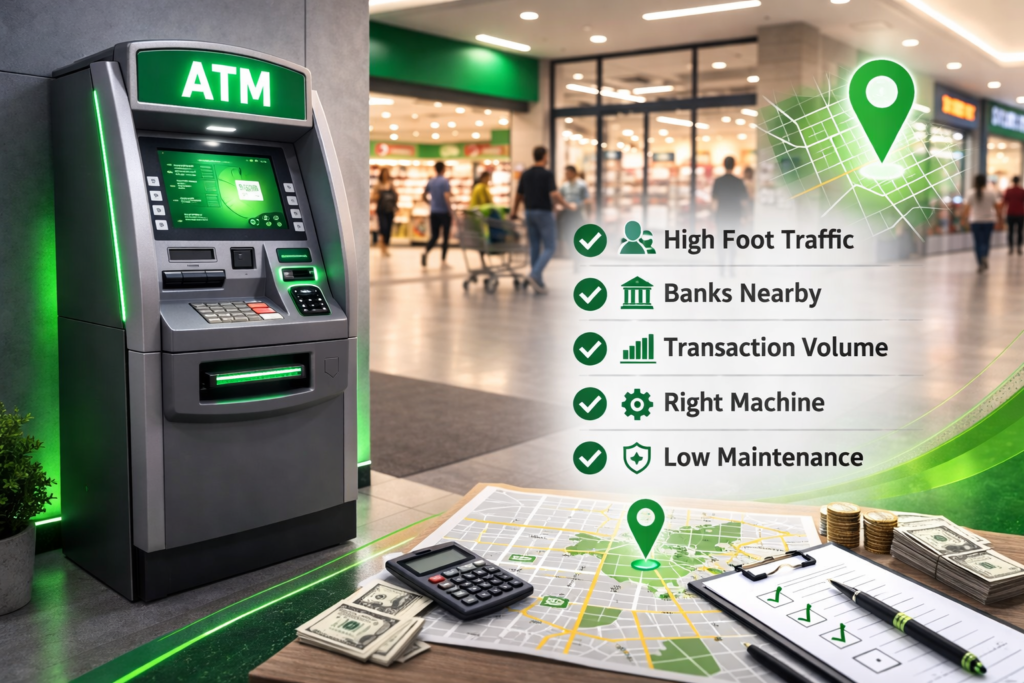
Most people walk past ATMs every day without thinking twice. But a small group of entrepreneurs sees something different , a machine that quietly collects $2–$3 every time someone presses “withdraw.” Starting an ATM business in 2026 is one of the most accessible passive income plays available to everyday Americans. No inventory. No employees. No storefront. Just a box on a wall, working for you 24/7.
This guide walks you through exactly how to start an ATM business from scratch , how much it costs, where to place machines, how to get locations, how to handle compliance, and how to actually make money. Let’s get into it.
What Is an ATM Business and How Does It Work?
An ATM business is simple: you own one or more ATMs, place them at high-traffic locations, load them with cash, and collect a surcharge fee every time someone uses them. That fee , typically $2.50 to $3.50 per transaction , gets split between you (the ATM owner), the location owner, and sometimes a third-party processor.
Here’s the basic money flow:
- Customer withdraws cash → pays a $2.50–$3.50 surcharge
- Processor takes a cut → typically $0.25–$0.50 per transaction
- Location owner gets a cut → typically $0.50–$1.00 (negotiated)
- You keep the rest → $1.50–$2.50 per transaction
Run the math on a machine doing 150 transactions per month at $2.00 net per transaction: $300/month from one machine. Scale to 10 machines and you’re looking at $3,000/month in mostly passive income. Scale to 50 and you’ve built a real business.
Two Models: Independent Owner vs. ATM Route Buyer
You have two main paths into this industry:
Build From Scratch
Buy machines, find locations yourself, install and operate. More work upfront, but lower cost and higher long-term margin. Best for people with time and hustle.
Buy an Existing Route
Purchase an established ATM route with machines already placed and earning. Revenue starts day one. Costs more upfront, but you skip the grind of sourcing locations. Best for people with capital. Learn how ATM routes work →
Step 1: Understand the Real Startup Costs
Before anything else, know what you’re getting into financially. The ATM business has a real barrier to entry , the machines and the cash vault , but it’s not as high as most people think.
| Item | Low End | High End | Notes |
|---|---|---|---|
| ATM machine (new) | $2,000 | $4,500 | Genmega, Hyosung, Nautilus |
| ATM machine (used) | $800 | $2,000 | Inspect before buying; check certifications |
| Vault cash per machine | $2,000 | $5,000 | Depends on cassette size and replenishment schedule |
| Processing setup | $0 | $200 | Most processors free to join; some charge setup |
| Installation/mount | $100 | $500 | DIY or pro; floor mount vs. through-wall |
| Business license/LLC | $50 | $500 | Varies by state |
| Insurance | $200/yr | $600/yr | Inland marine or business owner policy |
Realistic first machine total: $4,000–$8,000 including the machine, cash to load it, and setup costs. If you’re buying used and keeping things lean, you can get started for under $4,000.
Thinking about skipping the cash vault headache by buying an established operation instead? See our breakdown of ATM business for sale vs. building your own to compare real numbers.
Step 2: Choose Your ATM Machine
Not all ATMs are created equal. The machine you buy will determine your reliability, compliance status, repair costs, and long-term profitability. Here’s what matters in 2026:
Top Brands for New ATM Owners
Genmega , The most popular choice for independent ATM owners in the US right now. Affordable, reliable, easy to service. The G2500 and Onyx S series are excellent entry-level machines. Parts are widely available.
Hyosung (Nautilus Hyosung) , Slightly higher cost than Genmega but extremely well-built. The Halo II is a workhorse. Common in bars, convenience stores, and entertainment venues. Great resale value.
NCR , Bank-grade machines most often found at financial institutions. Overkill for most independent operators, but worth considering for high-volume locations like casinos.
💡 Key requirement: Your machine must support Triple DES encryption and be PCI PTS compliant. Any machine that doesn’t meet these standards cannot connect to the payment networks. Most ATMs manufactured after 2015 are compliant , but always verify before buying used equipment. See our full guide to choosing the right ATM machine for your location.
New vs. Used ATMs
New machines come with warranties (typically 1–2 years), current software, and no surprises. Used machines save money upfront but require careful inspection. Check the bill validator, the keypad, the receipt printer, and especially the compliance certifications. A cheap used ATM that’s out of PCI compliance is worthless , you can’t put it on the network.
For a full breakdown of what to look for when buying, visit our dedicated guide: ATM for sale , what no one tells you before buying your first machine.
Step 3: Set Up Your Business Structure
Operating as a sole proprietor is the fastest way to start, but forming an LLC is strongly recommended. Here’s why:
- Liability protection , If something goes wrong at a location (a customer trips over a cord, a machine malfunction causes an issue), your personal assets are protected
- Tax advantages , Business expenses, depreciation on equipment, vehicle mileage, and home office deductions all become available
- Professionalism , Location owners (bars, restaurants, stores) prefer signing agreements with a registered business
- Banking , A business bank account keeps your ATM cash separate and makes accounting clean
LLC formation costs $50–$500 depending on your state. Services like LegalZoom or your state’s Secretary of State website make it straightforward. Once your LLC is active, open a dedicated business checking account , you’ll use this account to load and track your vault cash.
Do You Need a Special License to Own ATMs?
In most US states, no special license is required to own and operate independent ATMs. However, some states (Texas, Florida, and a handful of others) require you to register as a Money Services Business (MSB) or file with the state banking department. Check your specific state’s requirements before going live.
You will need to register with FinCEN as a Money Services Business at the federal level if you’re processing transactions , which you are. This registration is free and done online at fincen.gov. It’s a simple form and takes about 20 minutes.
Step 4: Find and Sign Locations
This is where the real work is , and where most new ATM owners either win or lose. A machine in a dead location earns nothing. A machine in the right spot earns $500–$1,000/month.
What Makes a Great ATM Location?
Think like your customers. People use ATMs when they need cash and don’t want to drive to their bank. The best locations share a few traits:
High-Performers
- Bars and nightclubs
- Cannabis dispensaries
- Laundromats
- Gas stations (non-bank-owned)
- Dollar stores and small grocers
- Music venues and festivals
- Tattoo and nail salons
- Check cashing stores
Usually Weak
- Office buildings (employees use their bank)
- Upscale restaurants (credit card crowd)
- Shopping malls (already have bank ATMs)
- Suburban neighborhoods (low foot traffic)
- Any location near a free bank ATM
How to Approach Location Owners
Most new ATM owners overthink this. The pitch is simple: “I’ll install a free ATM in your business, I handle everything (loading, maintenance, compliance), and I’ll pay you a commission per transaction.”
That’s it. You’re offering a business owner free foot traffic, customer convenience, and passive income. Most of them will say yes if the numbers make sense for both parties.
Commission rates vary. For a low-traffic location, offering $0.25–$0.50/transaction is reasonable. For a high-volume bar or dispensary that generates 400+ transactions/month, you might offer $0.75–$1.00 to win the spot. The location owner never touches the machine , they just get a monthly check.
The Location Agreement
Always use a written agreement. It doesn’t need to be 20 pages , a one-page document covering these points is enough:
- Who owns the machine (you)
- Term of agreement (typically 1–3 years with auto-renewal)
- Commission amount and payment schedule
- Location owner’s obligations (provide power, maintain clear access)
- Your obligations (maintenance, compliance, cash loading)
- Termination clause (30-day notice for both parties)
Templates are available from most ATM processors and industry associations. Have a local attorney review it once before using it for all your locations.
Step 5: Choose a Processor and Get Connected
Every ATM transaction flows through a payment processor , a company that sits between your machine and the banking networks (Visa, Mastercard, Interac, etc.). Choosing the right processor matters more than most beginners realize.
What ATM Processors Do
The processor handles the transaction routing, keeps your machine on the network, manages compliance, and deposits your surcharge revenue into your bank account. They charge a per-transaction fee (typically $0.10–$0.50) and sometimes a monthly minimum.
Top Processors for Independent ATM Owners in 2026
- Cardtronics / Allpoint , Large network, known for retail and convenience store placements
- Fiserv (First Data) , Major processor used by many independent ATM businesses
- PayComplete / Transfirst , Popular with smaller operators, good support
- ATM Depot / ATM Solutions , Independent-operator-friendly; good for beginners
- Your ATM Machines (YAM) , Turnkey setup with machine purchase + processing bundle
Compare contract terms carefully. Watch for: minimum monthly fees, early termination penalties, who owns the surcharge revenue vs. the interchange income, and what happens if a machine goes offline. Some processors offer remote monitoring as part of the package , this is extremely valuable when you have multiple machines.
Step 6: Load, Install, and Go Live
Once you have a machine, a location agreement, and a processor account, it’s time to go live.
Installation Basics
Most standalone ATMs require:
- A standard 110V power outlet (dedicated circuit preferred)
- An internet connection , Ethernet is most reliable; cellular (4G) is available as a backup or primary connection for locations without reliable WiFi
- A hard floor anchor point if the location requires it (many bars and stores just want it freestanding)
Through-wall ATMs require a contractor for installation , they cut a hole in the wall, mount the machine so the screen and keypad face outside. These are less common for new operators starting out; freestanding lobbies and countertop units are simpler and cheaper to deploy.
Loading Cash
This is the most hands-on part of the ATM business. You need to physically visit each machine when it’s running low and refill the cassette with cash. For a machine dispensing $20 bills with a cassette that holds $8,000–$10,000, a busy machine might need a reload every 1–2 weeks.
A few things to know:
- Use your business bank account cash , this is your float, not income
- Track every load with a receipt or log , essential for accounting and reconciliation
- Establish a reload schedule , don’t wait for the machine to hit zero; set alerts at 20–30% capacity
- Consider armored cash loading as you scale , services like Brink’s or Loomis can handle reloads at ~$50–$150/visit, freeing your time
Step 7: Track, Optimize, and Scale
Once your first machine is running, the goal is simple: understand your numbers, optimize your worst performers, and add machines systematically.
Key Metrics to Track
| Metric | Target | Notes |
|---|---|---|
| Transactions/month | 100–300+ | Under 80 = location problem; over 300 = great spot |
| Net revenue/transaction | $1.50–$2.50 | After processor fees and location commission |
| Uptime % | 95%+ | Downtime = lost income; track with remote monitoring |
| Cash-on-hand days | 7–14 days | Balance between not running out and over-capitalizing |
| Revenue per machine/month | $200–$600 | Average across route; cut locations under $100 |
When to Cut a Location
Not every location you sign will perform. If a machine consistently does under 50–60 transactions per month after 3–4 months, the math rarely improves. Pull the machine, find a better spot, and move on. Don’t get emotionally attached to a location , the data tells you everything.
Scaling to 10+ Machines
The real leverage in an ATM business comes with scale. Going from 1 machine to 10 doesn’t require 10x the work , most of the systems (processing account, LLC, insurance, cash logistics) are already in place. Each additional machine is incremental revenue with mostly incremental effort.
By the time you reach 10 machines, consider:
- Hiring a part-time cash loader to handle reloads
- Upgrading to a remote monitoring platform to see all machine statuses in one dashboard
- Refinancing the business to acquire machines faster using cash flow from existing locations
- Acquiring an existing ATM route to jump ahead , buying a portfolio of 20 placed machines is often faster than building one location at a time. See our guide to ATM routes for sale to understand how route acquisitions work.
ATM Franchise vs. Independent: Which Path Is Right for You?
You’ll occasionally see offers for ATM franchises , essentially a branded system where you pay a franchise fee and operate under someone else’s system and brand. The appeal is the hand-holding: training, support, systems, and name recognition.
The downside? Franchise fees eat into your margins significantly, and in a business as straightforward as ATM ownership, you’re paying for support you could get for free from industry communities, processors, and manufacturer support lines. Most experienced operators recommend going independent.
That said, if you want to buy into an established system with training wheels, some ATM ISOs (independent sales organizations) offer turnkey programs that are franchise-adjacent without the formal franchise structure. You get training, machine sourcing, and a processor setup in exchange for a setup fee or a slightly higher processing rate. It’s worth researching if you prefer that structure.
How Much Can You Actually Make?
Let’s be direct with real-world numbers. The ATM business is not a get-rich-quick scheme, and anyone promising you “$10,000/month from 5 machines” is overselling. Here’s a more honest breakdown:
Conservative (Starter)
3 machines
80 tx/month avg
$1.75 net/tx
$420/month
Side income. Covers a car payment.
Moderate (Growing)
10 machines
130 tx/month avg
$2.00 net/tx
$2,600/month
Meaningful income. Reinvest to grow.
Strong (Operator)
30 machines
160 tx/month avg
$2.10 net/tx
$10,080/month
Full-time income. Replaces a job.
Getting to 30 machines takes 2–4 years for most people who start from scratch and reinvest their earnings. It’s not fast money. But it builds into something durable that runs largely without you once the systems are in place.
Common Mistakes New ATM Owners Make
1. Buying the Cheapest Machine Possible
An ATM that’s constantly jamming, going offline, or failing a compliance check costs you more in lost income and repair calls than you saved upfront. Buy a reliable machine from a reputable manufacturer. The Genmega G2500 costs around $2,200 new , that’s not the place to cut corners.
2. Skipping the Location Agreement
A handshake deal is not a business. Without a written agreement, a location owner can kick your machine out with zero notice the day after you drop a new machine there. Protect your equipment investment with a proper contract.
3. Under-Capitalizing the Cash Float
Your machine can’t earn money if it’s out of cash. Budget for a healthy cash float from day one , plan for $3,000–$5,000 per machine in working capital for the vault, separate from your operating funds.
4. Ignoring Compliance
FinCEN registration, PCI compliance, and ADA requirements (screen height, keypad accessibility) are not optional. Non-compliance can get your machine kicked off the processing network or result in fines. Know the rules before you go live.
5. Not Tracking Numbers Per Machine
You need to know which machines are making money and which aren’t. Your processor’s reporting dashboard will show transactions per machine. Review it monthly. Underperformers should be relocated , not kept out of inertia.
Is 2026 Still a Good Time to Start an ATM Business?
Yes , with some nuance. Cash use in the US has declined over the past decade, and digital payments continue growing. But cash hasn’t disappeared. Millions of Americans , particularly in lower-income demographics, rural areas, and certain business types like cannabis and entertainment , rely heavily on cash for daily transactions.
The operators being squeezed are those in generic, high-competition locations (strip malls, chain retail) where bank-owned free ATMs exist. Independent operators who focus on underserved niches , dispensaries, check-cashing areas, bars, festivals , continue to see strong transaction volumes.
Additionally, the exit opportunity has improved. As the industry matures, there are active buyers for established ATM routes, meaning you can build a portfolio and sell it in 5–10 years at a 3–5x annual earnings multiple. That’s a real wealth-building play. Learn more about how those transactions work in our guide to ATM businesses for sale.
Your First 90 Days: A Simple Action Plan
- Week 1–2: Form your LLC, open a business bank account, register with FinCEN as an MSB
- Week 2–3: Research and buy your first machine (new Genmega or Hyosung is safest). Use our machine selection guide to pick the right model for your location type
- Week 3–4: Identify 5–10 target locations in your area, visit in person, and pitch 3–5 owners
- Week 4–5: Sign a location agreement, set up your processor account, install and go live
- Month 2: Monitor transaction reports weekly; reload cash as needed; evaluate performance
- Month 3: If the first location performs well, identify your second. Start building the route.
Final Thoughts
The ATM business rewards patience and systems thinking more than hustle. The first machine is the hardest , you’re building processes, learning the equipment, figuring out what works in your market. By the third or fourth machine, it becomes systematic. By the tenth, it starts to feel genuinely passive.
Start lean. One machine, one great location. Learn the business before scaling it. The operators who succeed long-term are the ones who treat this like a real business , not a vending machine side gig , from day one.
Ready to find your first machine? Browse our guide to ATM machines for sale, or if you’d rather skip the startup phase entirely, explore what established ATM routes are going for in 2026.