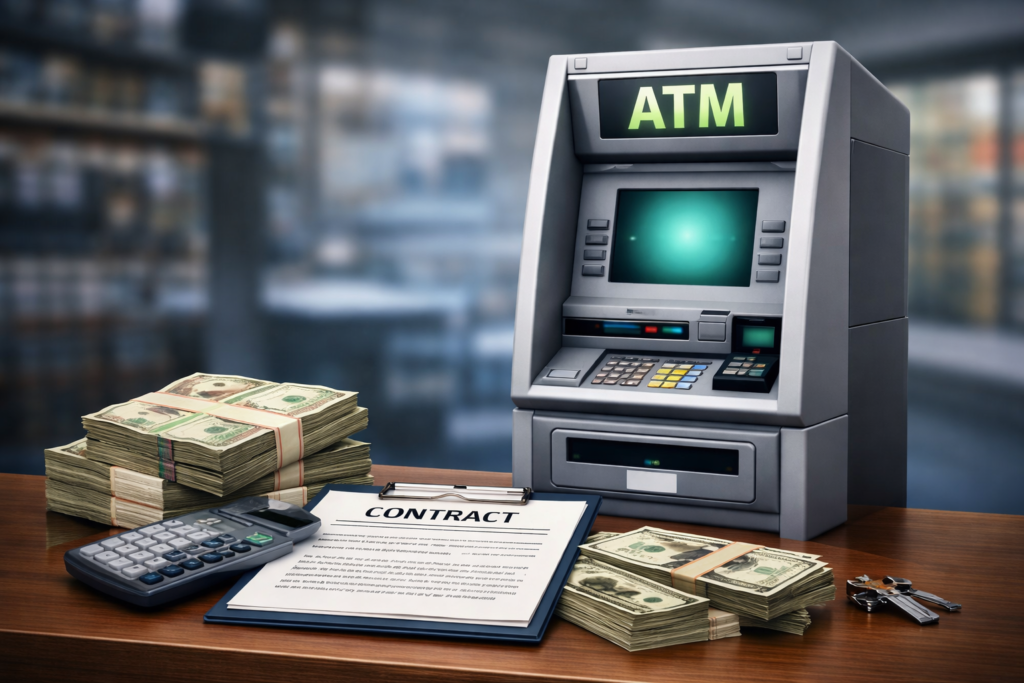
ATM stands for two completely different things depending on context. In banking, ATM stands for Automated Teller Machine — the electronic device you use to withdraw cash, check your balance, or deposit money. In texting and social media, ATM means At The Moment — a slang shorthand for “currently” or “right now.” Both meanings are extremely common, and the context of the conversation tells you which one is being used.
You got a text from someone saying “I’m busy ATM.” Your first thought was probably not a cash machine. But search for “what does ATM stand for” and you get banking results. Search for “ATM meaning in text” and you get slang guides.
The confusion is understandable. The same three letters carry two completely different meanings that have nothing to do with each other. This guide covers both fully, so regardless of why you searched, you will leave with the answer you need.
Banking
Automated Teller Machine
Texting
At The Moment
1967
Year the first ATM machine was installed
3.2M+
ATMs operating worldwide today
ATM in Banking: What Does ATM Stand For?
In the world of banking and finance, ATM stands for Automated Teller Machine. The name describes exactly what the device does: it is an automated (self-operating) machine that performs the duties of a bank teller, handling cash transactions without any human assistance.
Breaking down the three words helps make it clear:
- Automated — the machine operates on its own, without a bank employee guiding each transaction
- Teller — a reference to the traditional bank teller whose job was to handle deposits, withdrawals, and account inquiries at the counter
- Machine — the physical electronic device that replaces those in-person interactions
You may also hear ATMs called automated banking machines (ABM, common in Canada), cash machines, cashpoints (the term used widely in the UK), or hole-in-the-wall machines. All of these refer to the same device. In the United States, “ATM machine” is technically redundant (since “machine” is already in the acronym), but it is commonly used in everyday speech.
What Can an ATM Do?
The core function of an ATM is cash withdrawal, but modern machines handle far more than that:
| Function | Available At | Notes |
|---|---|---|
| Cash withdrawal | All ATMs | The primary function. Subject to daily limits set by your bank. |
| Balance inquiry | All ATMs | Check your current account balance on screen or via printed receipt. |
| Cash deposit | Most bank-owned ATMs | Not available at all machines, especially third-party ATMs in stores. |
| Check deposit | Many bank-owned ATMs | Modern machines scan the check directly without an envelope. |
| Fund transfer between accounts | Bank-owned ATMs | Move money between your own checking and savings accounts. |
| PIN change | Your own bank’s ATMs | Update your card’s personal identification number at the machine. |
| Bill payment | Some bank ATMs | Available at certain institutions where you have registered payees. |
How Does an ATM Work?
When you insert your debit card and enter your PIN at an ATM, a chain of events happens in seconds:
The ATM reads the chip or magnetic stripe on your card to identify your account and bank.
Your PIN is encrypted and sent over a secure network to your bank for verification. The PIN never travels in plain text.
Your bank checks that you have sufficient funds and that the transaction does not exceed your daily withdrawal limit.
The cash dispensing unit (CDU) feeds the correct number of bills from the internal cassette and pushes them through the cash slot.
A printed or digital receipt is offered as a record of the transaction. The ATM is required to offer a receipt for any transaction over $15.
The entire process typically takes 15 to 30 seconds. The cash dispensed is not “new money” from the ATM — it is your own money, pulled from your bank account balance at that moment.
ATM vs ABM vs Cashpoint: Different Names, Same Machine
Depending on where you are in the world, the same machine goes by different names. Here is a quick reference:
| Term | What It Stands For | Where It Is Used |
|---|---|---|
| ATM | Automated Teller Machine | United States, worldwide standard |
| ABM | Automated Banking Machine | Canada (though ATM is also used) |
| Cashpoint | Brand name turned generic term | United Kingdom (originally a Lloyds Bank trademark) |
| Cash Machine | Descriptive common term | United Kingdom and Ireland |
| Hole in the Wall | Informal term for through-wall ATMs | United Kingdom, informal |
| Bankomat | From German “Bankautomat” | Germany, Austria, Sweden, and other European countries |
A Brief History of the ATM Machine
The ATM did not appear fully formed. It was the product of multiple inventors working on related problems across different decades, and it took a New York blizzard to finally convince the American public to trust one.
1960: The Bankograph (New York)
American inventor Luther George Simjian installed an early prototype at a New York City bank. The Bankograph accepted cash and check deposits and used an internal camera to photograph each deposit as a receipt. It was removed after six months due to lack of use. Simjian later noted that the only people who seemed to want it were “prostitutes and gamblers who didn’t want to deal with tellers face to face.”
1967: The World’s First ATM (London)
Scottish inventor John Shepherd-Barron developed the idea while sitting in the bath, inspired by chocolate bar vending machines. Barclays Bank installed his machine at a branch in Enfield, North London on June 27, 1967. Actor Reg Varney was the first to use it. Instead of a plastic card, it used paper vouchers imprinted with radioactive carbon-14 ink. Customers could withdraw a maximum of £10 per transaction.
1969: The Plastic Card ATM (United States)
Dallas engineer Donald Wetzel developed the first ATM using the plastic cards with magnetic stripes that we still use today. His machine was installed at a Chemical Bank branch in Rockville Centre, New York.
1972: IBM Enters the Picture
IBM developed the 2984 Cash Issuing Terminal for Lloyds Bank, which named it the Cashpoint. This machine was the first to require a PIN for security, and it dispensed variable amounts directly debited from the customer’s account in real time. Lloyds Bank promoted it so aggressively that “cashpoint” became the generic term for ATMs throughout the UK.
1977 to 1978: Citibank Goes All In
Citibank chairman Walter Wriston bet more than $100 million on ATM technology, installing machines across New York City. The investment looked uncertain until January 1978, when a massive blizzard buried New York under 17 inches of snow and closed every bank branch for days. ATM usage jumped 20 percent during the storm. Citibank launched its “The Citi Never Sleeps” campaign shortly after, and the ATM became a permanent fixture of American financial life.
1979: Shared Networks Launch
The first shared ATM switching system went live on February 3, 1979 in Denver, Colorado, allowing customers of different banks to use the same ATM. This was the beginning of the ATM networks that make modern cash access so seamless.
Today
More than 3.2 million ATMs operate worldwide. There are ATMs in Antarctica. Most modern machines are EMV chip-compliant, many accept contactless payments via Apple Pay or Google Pay, and independent operators deploy them in bars, convenience stores, festivals, dispensaries, and thousands of other locations outside of traditional bank branches.
Not every ATM is owned by a bank. Thousands of ATMs in bars, convenience stores, hotels, dispensaries, and event venues are owned and operated by independent businesses. Every time you pay a surcharge fee at one of those machines, the money goes directly to the ATM operator, not a bank. It is one of the most accessible cash-flow businesses in the U.S., requiring as little as $3,000 to $8,000 to get started.
Types of ATMs: Not All Machines Are the Same
ATMs come in several configurations depending on where they are installed and who owns them:
| ATM Type | Who Owns It | Where Found | Deposit Capable? |
|---|---|---|---|
| Bank-owned ATM | Your bank or credit union | Bank branches, drive-throughs | Yes (most) |
| Freestanding retail ATM | Independent ATM operator | Convenience stores, bars, hotels | No |
| Through-the-wall ATM | Bank or operator | Building exteriors, drive-ups | Sometimes |
| Mobile / event ATM | Independent ATM operator | Festivals, fairs, temporary venues | No |
| Countertop / wall-mount ATM | Business owner or operator | Dispensaries, barbershops, nightclubs | No |
| Bitcoin / crypto ATM | Crypto kiosk operator | Convenience stores, malls | No (crypto only) |
The independent ATM operator category is larger than most people realize. In the United States, tens of thousands of small business owners and entrepreneurs deploy and profit from privately owned ATMs. These are not banks, and the machines they operate are withdrawal-only — but they generate income through the surcharge fee paid by each customer who uses them.
ATM in Texting: What Does ATM Mean in a Text Message?
When ATM appears in a text message, social media post, or online chat, it almost always means At The Moment — a casual shorthand for “currently” or “right now.”
The slang emerged in the early 2000s alongside the rise of SMS text messaging, when character limits made abbreviations valuable. Just as LOL, BRB, and OMG became part of digital shorthand, ATM became the quick way to say “at this particular point in time.”
ATM in Texting: Meaning and Usage
When someone uses ATM in a text, they are describing their current state, action, or availability. It functions the same way the word “currently” does in formal writing:
Examples of ATM in Texting
How to Tell Which ATM Meaning Is Being Used
Context makes the distinction easy. If you pay attention to the surrounding sentence, you will always know which ATM is intended:
| If the message says… | ATM most likely means… | Why |
|---|---|---|
| “I’m at the ATM, be there in 2 min” | Automated Teller Machine | The article “the” before ATM points to a physical object |
| “Can’t talk atm, I’m in class” | At The Moment | Describes current availability — a state, not a location |
| “The ATM fee was $3.50” | Automated Teller Machine | Discusses money, fees, banking context |
| “Loving this show atm” | At The Moment | Describes current feelings — no banking context whatsoever |
| “Where’s the nearest ATM?” | Automated Teller Machine | Asking about physical location of a machine |
The quickest rule: if ATM is preceded by “the” or “an,” it almost certainly refers to the banking machine. If ATM appears at the end of a sentence describing an action or feeling, it almost certainly means “at the moment.”
Is It Written ATM or atm?
Both are correct in casual texting. Lowercase “atm” is very common in text messages precisely because it avoids any ambiguity with the banking machine — seeing all caps “ATM” is more likely to make someone think of a cash machine. When people use “atm” in lowercase mid-sentence, it reads unmistakably as the slang term. Either way, the surrounding context eliminates any confusion.
Other Less Common Meanings of ATM
Beyond banking and texting, ATM shows up in a few specialized fields. These are rarely the intended meaning in everyday conversation but worth knowing:
| Field | ATM Stands For | Context |
|---|---|---|
| Chemistry / Physics | Atmosphere (atm) | Unit of pressure equal to the average atmospheric pressure at sea level. Used in chemistry, physics, and engineering. 1 atm = 101.325 kPa. |
| Networking / Technology | Asynchronous Transfer Mode | A high-speed networking standard used in telecommunications. Largely replaced by internet protocols but still found in some legacy systems. |
| Aviation | Air Traffic Management | Systems and procedures for managing aircraft movement. Used by aviation professionals and regulatory bodies. |
| Military | Anti-Tank Missile | A weapons system designation in military contexts. Rarely encountered outside defense/military reporting. |
In everyday conversation, banking and texting account for the overwhelming majority of ATM usage. The others are specific to their professional domains and would only appear in technical documentation or specialized reporting.
Frequently Asked Questions
What does ATM stand for in banking?
ATM stands for Automated Teller Machine. It is an electronic self-service device that allows bank customers to withdraw cash, deposit money, check account balances, and perform other basic banking transactions without visiting a branch or interacting with a bank employee. The word “teller” refers to the bank employee role the machine replaces.
What does ATM mean in a text message?
In text messages and online conversation, ATM means “At The Moment.” It is used as a casual shorthand for “currently” or “right now.” Someone texting “I’m busy ATM” means they are busy at this particular moment. It is informal slang, best suited for casual conversations rather than professional communication.
What does ATM stand for in texting slang?
ATM stands for “At The Moment” in texting slang. It developed in the early 2000s when SMS character limits made abbreviations useful. It functions as a synonym for “currently” and is used to describe one’s present state, activity, or availability. Other similar time-related abbreviations in texting include RN (right now), BRB (be right back), and NGL (not gonna lie).
Why is it called an Automated Teller Machine?
The name comes from the role it automates. A bank teller is the person at the bank counter who handles cash deposits, withdrawals, and other transactions. When electronic self-service machines were developed that could perform those same functions without a person present, they were called Automated Teller Machines, because they automated what a teller used to do manually.
Is it wrong to say “ATM machine”?
Technically yes, since “ATM machine” is redundant — the M already stands for Machine. But “ATM machine” is used so widely in everyday American speech that it is generally understood and accepted. It falls into the same category as “PIN number” (PIN = Personal Identification Number) — technically redundant but practically harmless and universally understood.
What is the difference between an ATM and a cash machine?
There is no functional difference. “Cash machine” is simply the British English term for what Americans call an ATM. Both refer to the same electronic device used to withdraw cash from a bank account using a debit or ATM card. Similarly, “cashpoint” in the UK and “bankomat” in parts of Europe all refer to the same machine.
Who invented the ATM?
The ATM does not have a single inventor. Multiple engineers contributed key pieces across different decades. The world’s first deployed ATM is generally credited to John Shepherd-Barron, whose machine was installed at a Barclays Bank in Enfield, London in 1967. The first ATM using plastic magnetic-stripe cards — the type we recognize today — was developed by Donald Wetzel and installed in New York in 1969. IBM contributed key technology including the magnetic stripe standard and the first network-connected ATMs in the early 1970s.
What does “a.t.m” mean with periods?
A.t.m with periods between letters is simply a stylistic variation of ATM. Some people write abbreviations with periods to emphasize each letter. Both ATM and a.t.m. carry the same meanings in banking (Automated Teller Machine) and texting (At The Moment). The period version is less common in casual digital communication but occasionally appears in more formal written contexts.
The Bottom Line
ATM means two entirely different things depending on context. In banking, it is the Automated Teller Machine that has dispensed cash on demand since 1967 and now numbers more than 3.2 million worldwide. In texting, it is “At The Moment” — a casual, fast shorthand for currently. Context makes the distinction clear every time: one is a machine you visit, the other is a word you use to describe what you are doing right now.
If you came here because you are curious about ATMs as a machine — how they work, what they cost, or how independent operators make money from them — the guides below go deep on each of those topics.
If you came here for the texting definition, now you know: “I’m studying atm” means the person is studying right now, not standing in a bank lobby.
Explore more: ATM machines for sale — how to buy an ATM business — how to start an ATM business in 2026 — ATM withdrawal limits by bank — Nautilus Hyosung ATM models and prices