If you run a bar, convenience store, laundromat, or any cash-friendly business, you have probably wondered whether you can get an ATM in your store without paying for it. You can. It is one of the few genuinely free upgrades in retail. But “free” hides a trade, and here is the part most articles skip: the ATM company usually wants your location more than you want their machine. Understanding that flips the whole conversation in your favor.
I have been placing and servicing ATMs for years, and this is the honest version of how free ATM placement really works: why operators chase good locations, how busy your store actually needs to be, how the money splits, which companies offer it, and the fine print that decides whether the deal is good for you or good only for them.
The part nobody tells you: they want your location
Here is the mindset shift. Store owners think they are asking for a favor. In reality, ATM operators are constantly hunting for good spots, because an empty machine costs them money and a busy one is a steady income stream. A single machine in the right location can run hundreds of withdrawals a month, and at a $3.00 surcharge that is real revenue for them.
So the question is not “will someone let me have a free ATM?” It is “how busy is my store, and how much leverage does that give me?” A high-traffic location does not beg for a machine. The operator competes to place one there, and a smart owner uses that to negotiate a cut of the surcharge, better placement, and better terms. A slow location has less pull, but still has options. Everything below comes down to your volume.
What “free ATM placement” actually means
There is no hidden bill. The machine, the install, the paper, the processing connection, and the repairs are genuinely covered by the operator. The trade is that the operator earns the surcharge on every withdrawal, which is how the machine pays for itself. What people loosely call “free placement” is really a few different arrangements, and knowing which one you are being offered is the most important thing on this page.
1. Full-service placement
The operator provides the machine, installs it, loads their own cash, handles processing and repairs, and keeps the surcharge. You pay nothing and do nothing. On a busy location you should still negotiate a share (see below). This is the most common “free” deal.
2. Revenue-share placement
Same hands-off setup, but you earn a slice of every surcharge, commonly $0.25 to $1.00 per withdrawal, or a straight 50/50 split. Still free to you. This is what a busy store should insist on.
3. Load-your-own-cash
The operator supplies the machine and processing, but you stock it with your own cash and keep the entire surcharge. Not “free” in the cash sense (your money sits in the machine), but the highest payout if you have the float and the volume.
4. Buy your own (for comparison)
Not placement, but worth knowing: a new retail ATM runs about $2,000 to $3,500 (see current ATM machine prices). If your location is busy, buying pays for itself in months and you keep every dollar. High-volume owners often end up here.
How busy does your store need to be? (the honest tiers)
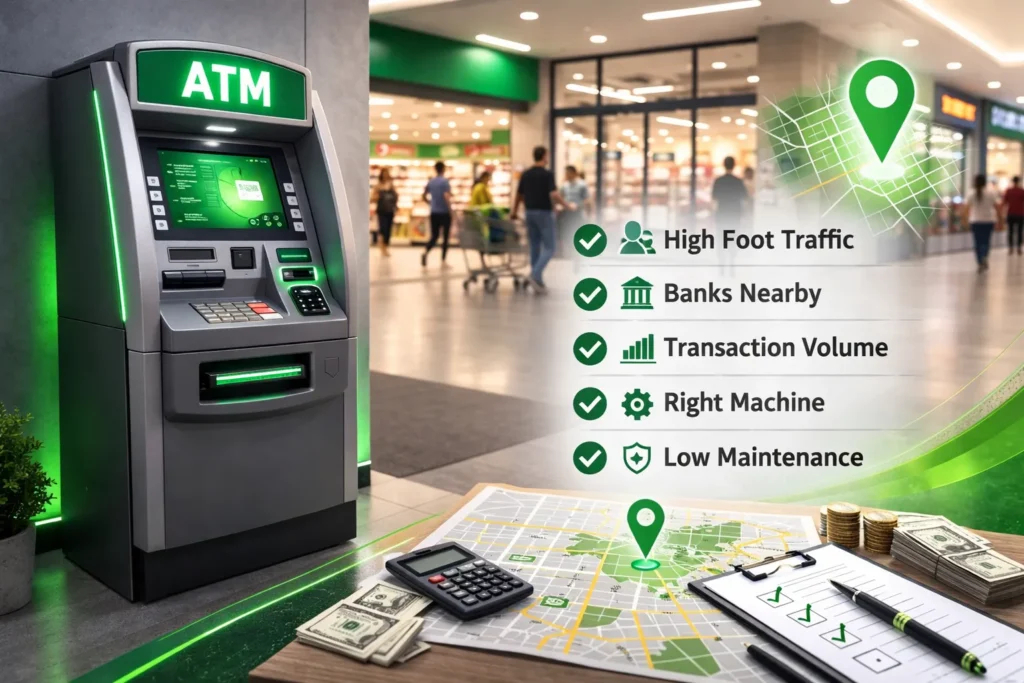
Operators do not place machines everywhere, because a machine that sits idle costs them money. Before anyone installs one, they are quietly estimating how many withdrawals your location will do per month. Based on years of doing this, here is the real breakdown, and what each tier means for your leverage.
Operators will compete for you
High foot traffic, cash-heavy, hundreds of transactions. This is the location every operator wants. Do not accept a plain “we keep the surcharge” deal here. Push for a real revenue share (a per-transaction payout or 50/50), and they will still handle the machine, the cash, the processing, and the service. You do nothing and you get paid. This is where a busy bar or a high-volume convenience store can earn a meaningful monthly check just for the floor space.
Easy free full-service placement
A good, steady location. Operators are happy to place a machine here at no cost and do everything for you. You may not get a large surcharge share, but it is worth asking for a modest per-transaction cut. Even without one, you get the customer convenience and foot traffic at zero cost and zero work.
Free may not be on the table, but you still have options
A slow location may not generate enough surcharge to cover the operator’s fixed costs (processing, connectivity, cash runs, and service can total $60 to $150 a month per machine). An operator may pass on a free full-service deal here. That does not mean no machine. Two common paths: load your own cash and keep the whole surcharge, or agree to pay a small monthly fee, often $50 to $100, so the operator still supplies and services the machine while covering their costs. Either way you get an ATM; you just structure the deal to make the numbers work.
How the money actually works
To judge any offer, you need to know where the money comes from. When a customer withdraws cash, two separate fees exist, and they are not the same thing.
- The surcharge is the flat convenience fee the machine charges, the “$3.00 fee” the customer approves on screen. The operator sets it and keeps it (or splits it with you). In 2026 a typical retail surcharge runs $2.50 to $3.50, with $3.00 common and busy urban spots pushing $3.50 to $4.00. This is the money a revenue-share deal divides (more on how ATM surcharge fees work).
- Interchange is a small fee the customer’s own bank pays into the card network, roughly $0.28 on a Mastercard-network withdrawal. On a single machine the operator usually keeps 100% of the surcharge and sees little interchange, so surcharge is the number that matters to you.
The flow: a customer dips a card and approves the surcharge on screen. The machine routes the request through a processor to the card network (Visa/Plus, Mastercard/Cirrus, STAR, PULSE, Allpoint), the bank approves it, and cash is dispensed from the cassette. The transaction settles the next business day, and the operator is funded by ACH for the cash dispensed plus the surcharge, minus processing costs. In a revenue-share deal, your cut is typically paid out by ACH as well.
What a surcharge share is really worth to you
Say your location does 300 withdrawals a month at a $3.00 surcharge. That is $900 in surcharge revenue. Common ways it gets split:
- Per-transaction: you keep $0.50 to $1.00 per withdrawal, so $150 to $300 a month.
- 50/50: you split the surcharge down the middle, around $450 a month (before the operator’s costs in some deals).
- Base-rate + overage: the operator keeps a fixed amount per transaction and you keep anything above it, common where the surcharge is set higher.
- Flat monthly: a set figure like $100 a month regardless of count, simplest for a smaller location.
Best places to put an ATM (and why they work)
Volume is really a function of business type. These are the locations where ATMs perform best, and the reason why.
| Location type | Why the ATM performs |
|---|---|
| Bars & nightclubs | Cash tips, cover charges, tabs, and card-shy patrons. Among the highest-volume ATM spots there is. |
| Convenience stores, bodegas, gas stations | Steady all-day foot traffic and customers who expect cash on hand. |
| Liquor & smoke/vape shops | Cash-heavy by nature, and card processors often drop these businesses, so an ATM fills the gap. |
| Laundromats | Machines eat cash and quarters. An ATM is nearly a requirement. |
| Barbershops, salons, tattoo & nail shops | Cash tipping culture and service payments keep withdrawals steady. |
| Restaurants, especially cash-discount | If you offer a cash price to dodge card fees, an ATM keeps customers paying cash. |
| Dispensaries | Cards are often blocked at the banking level, so cash access is essential. (These frequently use a specialized or cashless setup.) |
| Festivals, food trucks, flea markets, events | Best served by a mobile or event ATM rather than a fixed placement, but volume can be huge. |
Placement inside the store matters too. The best spot is visible from the entrance or near the register, well-lit, and not tucked in a back corner. A machine people can see is a machine people use.
What the operator provides, and what you provide
The operator handles
The machine, delivery and install, the processing connection and Terminal ID, loading cash (in full-service), repairs and paper, surcharge setup, network compliance, and next-day settlement. If it breaks, that is their problem.
You provide
A few square feet near traffic, a standard 110V outlet, and an internet path (a wired ethernet drop or a cellular connection the operator supplies). That is essentially it.
You do not need a license, you do not touch the cash in a full-service deal, and you are not liable for the machine. Your only real jobs are keeping it powered and online and letting the operator in to service it.
Companies that offer free ATM placement
Almost every ATM company runs some form of free-placement or revenue-share program, so you have plenty of options. National operators that publicly advertise free placement include:
- Prineta USA: nationwide full-service placement and a 50/50 revenue-sharing partnership program.
- NationalLink: free retailer placement with all processing included.
- ATM Money Machine: full-service placement with a surcharge split for the host.
- Lieberman Companies: free placements across bars, salons, convenience stores, laundromats and more.
- National ATM Systems (NASATM): free machine placement for qualified locations.
- ATM America: full-service program covering equipment, cash, and maintenance.
Do not overlook local and independent operators. A nearby operator can often service your machine faster, is more willing to negotiate a fair surcharge split, and is easier to reach when something goes wrong than a national call center. When you compare, ask each one the same questions: what will the surcharge be set to, what is my share, who loads the cash, how fast is service, and how long is the term.
The fine print that separates a good deal from a bad one
Contract length and exclusivity
Placement agreements commonly run 12 to 60 months, and many include exclusivity (no competing machine). Longer is not automatically bad, but a 5-year lock with no revenue share and no performance-out clause is a red flag. Ask what happens if the machine underperforms or if you sell the business.
Who sets the surcharge, and do you share it
The operator sets the surcharge amount. In a plain full-service deal they keep all of it, fine if your volume is modest, but if your location is busy that stream is worth real money and you should negotiate a share before signing. Always ask two questions first: “What will the surcharge be set to?” and “Do I get a share of it?”
Cash, and what shows on screen
In a full-service deal the operator loads and refills the cash, so their money sits in your machine, not yours (here is how much cash an ATM holds). Federal rules (Reg E) require the machine to show the exact surcharge on screen and let the customer cancel with no fee before completing, so there are no surprise-fee complaints landing on you. The old requirement for a physical fee sticker on the machine was removed back in 2012; the on-screen notice is what is required now.
When it is smarter to buy your own
If your location proves out at a few hundred withdrawals a month, do the math on owning. A $2,500 machine against several hundred dollars a month in surcharge pays for itself in well under a year, after which you keep everything. Owning and running machines is a small business of its own; here is how to start an ATM business. Free placement is the right way to start and test a location. It is not always the right way to run a proven one.
How to actually get a free ATM placed
- Contact an ATM placement company (or a few). Tell them your business type, location, and roughly how busy you are. Getting two or three offers gives you leverage.
- Qualify the location. They estimate monthly volume from your business type and traffic. This is where you ask about full-service versus revenue-share.
- Negotiate and sign. Read the term length, exclusivity, surcharge, and your share (see what a real ATM placement agreement looks like). This is where you negotiate, not after.
- Install and connect. The operator delivers the machine, plugs it into power and internet, and provisions it with the processor (this is where the Terminal ID that identifies your machine on the network is issued).
- Go live. A test transaction clears, the cash is loaded, and the machine is open. Withdrawals settle the next business day, and your share is paid out by ACH.
Red flags when choosing an ATM placement company
- They will not tell you the surcharge amount, or refuse to discuss a share on a clearly busy location.
- A long lock-in (48 to 60 months) with exclusivity and no way out if the machine underperforms.
- No local service. If the nearest technician is three states away, downtime will be long.
- Vague answers on who loads and insures the cash.
- Pressure to sign same-day. A real operator lets you read the agreement.
Frequently asked questions
Is it really free to have an ATM placed in my store?
Yes. In a full-service placement the operator covers the machine, install, cash, processing, and repairs, and earns their money back through the surcharge. You pay nothing. On a busy location you can also negotiate a share of that surcharge.
How busy does my business need to be to get a free ATM?
Operators love locations doing 300 or more withdrawals a month, and compete hard for 500 to 700+. Around 150 to 300 a month still qualifies easily for free full-service placement. Under about 100 a month you may not get it free, but you can load your own cash and keep the surcharge, or pay a small monthly fee (often $50 to $100) so the operator still supplies and services the machine.
How much can I make from an ATM in my business?
In a revenue-share deal, commonly $0.25 to $1.00 per withdrawal, or a 50/50 split. A location doing 300 withdrawals a month can put $150 to $450 in your pocket depending on the deal. In a plain full-service deal you earn nothing directly but pay nothing and benefit from the foot traffic. If you own the machine, you keep the full surcharge.
Who loads the cash in the machine?
In full-service placement the operator loads and refills it with their own cash. In a load-your-own arrangement you stock it yourself and keep the entire surcharge in exchange for tying up your cash and doing the refills.
Which companies offer free ATM placement?
Most ATM companies do, including national operators like Prineta, NationalLink, ATM Money Machine, Lieberman, National ATM Systems, and ATM America, as well as local independent operators. Compare a few, and favor one that is upfront about the surcharge, your share, and local service.
How long does installation take?
Once you sign, install and activation usually happen within one to two weeks. The machine needs power, internet, and a Terminal ID from the processor before it can go live.
Can I remove the ATM if it does not work out?
That depends on your agreement, which is why the term length and any early-termination or performance clause matter. Read them before you sign, and favor operators who will relocate or remove an underperforming machine rather than lock you in.
Want an ATM placed in your business?
Tell us your business type, location, and how busy you are, and we will give you an honest read on whether it is a good fit and what the best arrangement would be. No cost, no obligation.
Get the ATM industry update
New guides, pricing news, and operator tips from someone who actually runs machines. Free every week, unsubscribe any time.